
“Technology is nothing. What’s important is that you have a faith in people, that they’re basically good and smart, and if you give them tools, they’ll do wonderful things with them.” — Steve Jobs
THERE IS A MASSIVE elephant in the contemporary art world right now, and it is shaped like an algorithm.
If you browse art forums or social media, the conversation around Artificial Intelligence (AI) is often filled with anxiety, frustration, and a deep-seated fear of replacement. Many artists look at generative AI and see a threat—a tech-driven machine built to copy human styles, automate raw emotion, and bypass the sacred, messy process of putting brush to canvas or paper to glue. It’s a completely valid response. Art is fundamentally human; it is born from lived experience, struggle, and soul. The idea of outsourcing that to a server farm feels profoundly wrong.
But what if we are looking at the wrong side of the digital canvas?
In an earlier piece, we explored the concept of a Dawn of Digital Renaissance, looking at how AI can offer objective, rapid-fire feedback on completed works. But technology is moving faster than ever, and the newest developments have shifted AI from a passive checking tool into something far more valuable: a living, breathing Studio Assistant.
AI isn’t here to do the creative workfor you. It is here to handle the friction, the administrative weight, and the technical roadblocks, leaving you with more time, more mental energy, and a clearer focus for your actual art practice.
Here is how you can use AI today as a powerful, collaborative partner to elevate your studio practice—without sacrificing a single ounce of your human touch.

1. The Dynamic Critique: Seeing Your Work with an “Editor’s Eye”
Every artist knows the frustration of hitting a wall. You’ve been staring at a mixed-media piece, a painting, or a complex layout for days, and you’ve completely lost your objectivity.
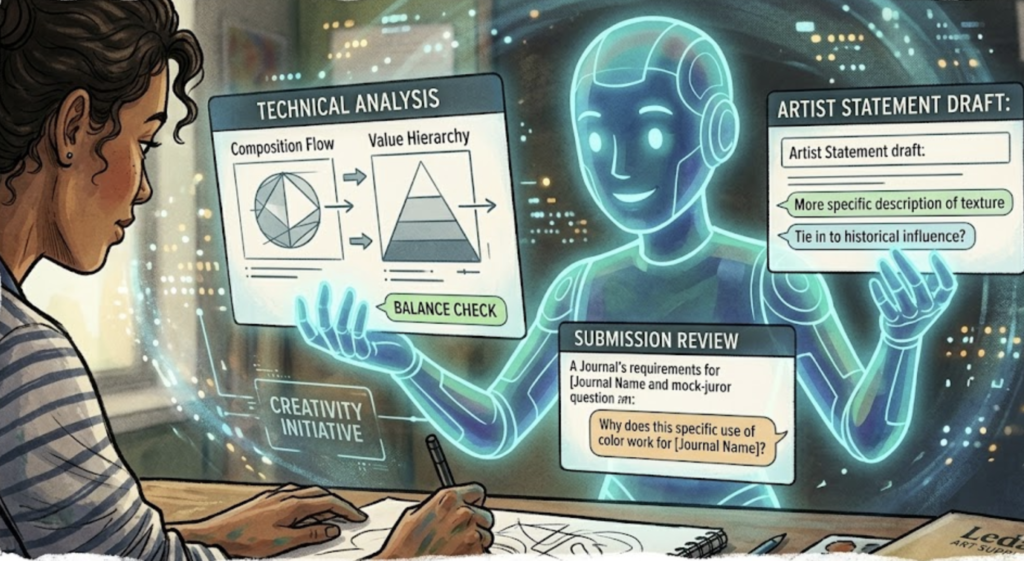
Instead of just asking an AI if a piece looks “good,” you can now ask it to analyze highly technical, compositional frameworks. Think of it as a master class instructor sitting in your studio. You can upload a photo of your work-in-progress and ask it to break down specific artistic elements:
- Value Structure:“Look at this composition. If you convert it to purely black and white, where does the visual focal point land? Is the contrast balanced, or is the eye getting trapped in a dead zone?”
- Spatial Flow & Movement:“Analyze the negative space. Does the composition guide the viewer’s eye smoothly through the piece, or is there a hard visual block that stalls the momentum?”
The AI doesn’t change a line of your work. It simply gives you an objective, technical reflection, helping you see your own canvas with fresh eyes so you can make the final, intuitive human adjustments.
2. Breaking the Curse of the “Artist Statement”
For many of us, the hardest part of being an artist isn’t making the art—it’s writing about it. Grant applications, gallery submissions, and literary journal packages often require polished artist statements, bios, and thematic descriptions. Trying to translate a deeply emotional, visual piece into strict, academic text can feel paralyzing.
AI is the ultimate cure for the blank page. You don’t have to let it write your statement from scratch. Instead, talk to it like a trusted friend. Tell it:
“I just finished a series of abstract collages using muted earth tones, eroded textures, and subtle nods to ancient history. Here is a brain dump of how I felt while making it…” The AI can take your raw, unedited thoughts and structure them into a beautifully articulated, professional draft. It handles the syntax, grammar, and formal pacing, while you maintain absolute control over the heart and meaning of the words.

3. The “Curator’s Desk” Submission Strategy
If you are submitting your work to competitive art and literary journals, you know how exhausting the rejection cycle can be. Every editor has a slightly different aesthetic.
You can use AI to bridge that gap. Paste the mission statement, past publication descriptions, or submission guidelines of a specific journal into the AI. Then, describe a few different compositions you are working on and ask:
“Act as the chief editor of this specific journal. Based on our aesthetic history, which of these three thematic directions would be most compelling to our editorial team, and what is the single toughest question a juror might ask about this work?”
By using AI as a mock juror, you can anticipate critiques, refine your presentation, and dramatically increase your confidence before you hit “submit.”
4. Unlocking the “Atmospheric Matrix” for Titles
Naming a piece of art can feel like trying to catch lightning in a bottle. A great title adds layers of depth; a bad one can cheapen a beautiful composition.
Instead of asking an AI for a generic list of titles, give it an atmospheric framework. Tell it the textures, colors, and emotional undercurrents of your piece, and ask for options broken into distinct conceptual buckets:
- Poetic & Grounded:Short, earthy, evocative titles.
- Archival:Titles that make the piece sound like an intriguing museum artifact.
- Paradoxical:Capturing the tension between heavy and light themes in the work.
Suddenly, you have an expansive menu of words to spark your imagination, helping you find that perfect linguistic match for your visual creation.

The True Spirit of the Digital Renaissance
When we strip away the hype, AI is just another tool in the history of human expression. When the camera was invented, painters panicked, believing photography would kill the medium entirely. Instead, it freed painters from the burden of hyper-realism and birthed Impressionism, Cubism, and Modern Art.
The newest AI tools aren’t a replacement for your creative soul—they are an invitation to clear away the administrative clutter, the self-doubt, and the technical bottlenecks. It allows you to step into your studio unburdened, focused entirely on the pure, joyful act of creation.
Empowering Creativity Together
This educational essay is brought to you by the Creativity Initiative, a 501(c)3 tax-exempt organization dedicated to nurturing creativity and promoting mental well-being through art education and accessibility.
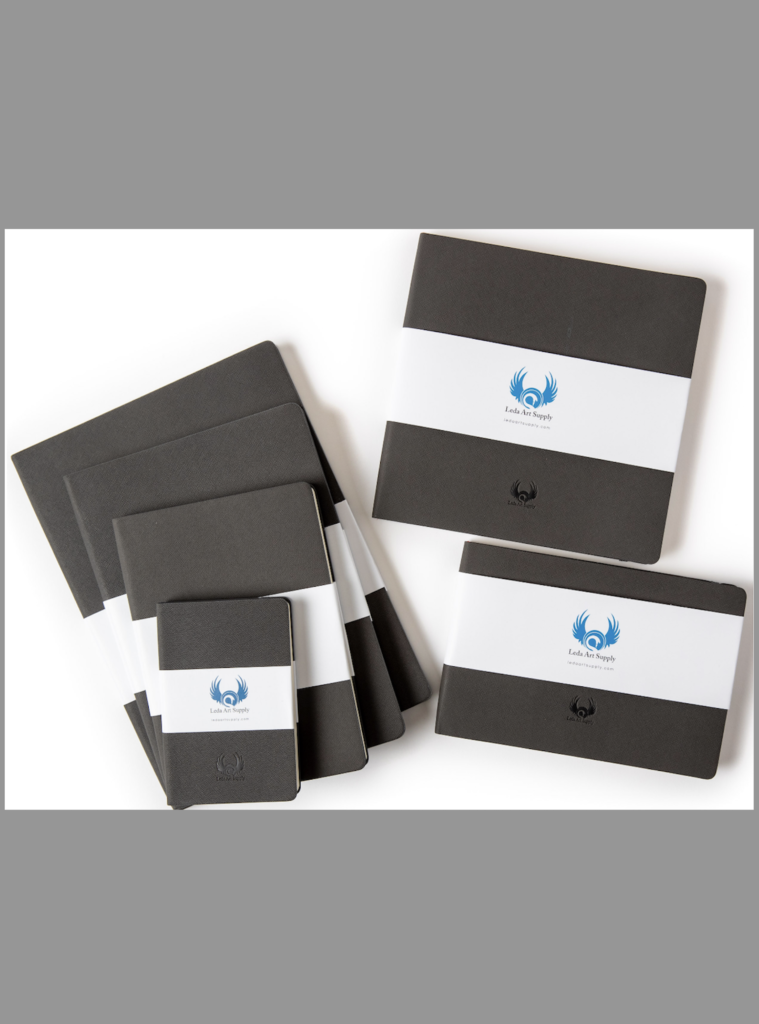
If you’d like to support our mission to bring art education and supplies to individuals of all ages, consider trying out our premium sketchbooks and tools from Leda Art Supplyon Amazon. Every purchase helps us empower more people to express themselves freely. Check out Leda Art Supply sketchbooks